


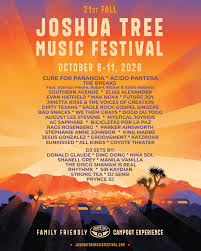
An organ trio, a choir and a fiddle-powered dance set can all get a crowd moving. They simply make the invitation differently. Joshua Tree’s Fall lineup is a good place to hear those differences—and to discover that the music you love has relatives you have not met yet.
For October 8–11, the festival’s lineup connects Dallas hip-hop, Memphis soul, Colombian electronics and Togolese guitar with a lively California contingent. This is not a test of how many names you recognise. A few good starting points will get you much further than pretending to know the whole lineup.
Your first listening map
| Your appetite | A place to begin | A connection worth following |
|---|---|---|
| Funk that gets into the knees | The Breaks | Southern Avenue; We Them Grays |
| Voices that fill the space | Southern Avenue | Jimetta Rose & The Voices of Creation |
| Words with a band behind them | Cure for Paranoia | The live-band side of the wider program |
| Folk instruments on a dance floor | Elias Alexander | Evan Hatfield; The Dirty Texans |
| Percussion with several conversations happening at once | Dogo du Togo | Ácido Pantera; Bicicletas Por La Paz |
| Electronic music with an instrumental personality | Bad Snacks | Elias Alexander; Future Joy |
These are listening suggestions, not a schedule. The pleasure is in hearing why one name might lead you to another.


Start with The Breaks
The Breaks brings together Eddie Roberts, Stanton Moore and Robert Walter. Their other bands—The New Mastersounds, Galactic and The Greyboy Allstars—already make a useful extended listening list. Here, guitar, drums and Hammond organ become one small, flexible funk machine.
The music draws on boogaloo and the organ-trio tradition. In plain terms, expect a rhythmic conversation: guitar phrases clipped into the beat, drums pushing and relaxing around them, and organ filling out the sound and adding melodic colour. The interest is not only in solos. It is in how three players stretch the rhythm without losing the beat.
Their self-titled debut is a good introduction, with “Hasheesh” and “Party Like a Rich Kid” among the starting points. The record includes guest horns and percussion; the festival bills the core trio. Walter’s account of the group emphasises their long friendship. That is the human appeal behind the impressive credits: a new band with years of familiarity already inside it.
For anyone whose festival taste runs towards funk, breaks and generous dance floor energy, this is an excellent doorway into the live-music side of the weekend. You can pay close attention and dance at the same time. Neither activity spoils the other.
Follow the voice towards Memphis
Southern Avenue builds its force differently. Lead singer Tierinii Jackson, guitarist Ori Naftaly, drummer and singer Tikyra “T.K.” Jackson, and singer-percussionist Ava Jackson bring a family relationship into the ensemble. The sisters’ voices are part of the band’s identity, not an extra layer added after the song is finished.
Their album Family makes that connection explicit. Blues guitar and gospel-informed singing sit inside a rhythm section that knows the value of a repeating figure. “Rum Boogie” looks back to the band’s early playing days; “So Much Love” offers a more direct soul entry point. The music can lift without constantly speeding up. A phrase repeated with more conviction, or a harmony answering the lead, does its own work on the body.
Follow that appetite for voices into Jimetta Rose & The Voices of Creation. Rose and organist Jack Maeby founded the Los Angeles choir in 2019, and its roots include weekly gatherings in Leimert Park. Soul, jazz and gospel are useful signposts, but the central attraction is a group of people giving a melody more than one human grain.
Listen for how a lead line changes when the choir answers it. The response can make a private sentiment feel communal without requiring everyone in the audience to sing. This is a different sort of scale from louder production: more voices, more texture, more people inside the sound.
Give the words your attention
Cure for Paranoia brings Dallas into the mix through Cameron McCloud, Tomahawk Jonez and Jay Analog. The alternative hip-hop collective works with personal writing and a performance identity larger than one vocalist standing over a backing track.
McCloud’s delivery gives the group a clear focal point. Start with the group’s own recordings and live videos, following the way a sentence sits against the rhythm: a phrase can push forward, hold back or make space for a response. That physical relationship is part of what makes rap rewarding in a live-band festival setting. Words are doing rhythmic work as well as carrying the story.
This is an invitation for listeners who sometimes drift away when a festival turns entirely instrumental. Stay with the voice. Then notice what the musicians and production do around it. The next discovery might be the rhythm beneath the line that first caught you.
A fiddle can be a dance instrument
Elias Alexander offers one of the weekend’s most appealing crossings between acoustic and electronic music. Scottish and American folk influences meet looping and production, with fiddle, bagpipes and other instruments supplying distinctive melodic voices.
“FIDDLE DISCO!” is an unusually efficient introduction to the proposition. Instead of treating the fiddle as a decorative solo placed on top of a beat, think about its bowing as a source of rhythm. A repeating phrase can become the part your feet follow. Live looping lets an instrumental idea return while another develops beside it, so the construction becomes part of the performance’s appeal.
That makes Alexander a useful bridge for someone who loves bands but is curious about electronic sets—or the reverse. Familiar instrumental expression can make electronic music more immediately inviting. There is no need to choose between appreciating the hands and enjoying the beat.
Evan Hatfield makes another crossing with sitar and electronic production, while The Dirty Texans, Danny and Johnny Kongos, draw on country and old-time references alongside live guitar, keys and electronics. Their name hides a geographical joke: their story begins outside Texas, although they are now based in Austin. JTMF’s program offers several ways for an instrument to escape the room you expected to find it in.
Let the rhythms overlap
Dogo du Togo’s Avoudé is the place to explore his work with The Alagaa Beat Band. After leading Elikeh in Washington, D.C., Dogo returned to Lomé to develop his solo recordings with Togolese collaborators. Guitar, hand percussion and repeating vocal ideas give the music several moving parts to follow.
Try staying with one guitar figure, then moving your attention to the percussion around it. That is a useful way into interlocking rhythm: the musicians do not simply double one beat. Several patterns share the space. Once those relationships begin to register, the music can feel busier and more spacious at the same time.
Ácido Pantera approaches the dance floor through Colombian musical references and electronic production. The Bogotá duo of Juan Por Dios and Diego Veira brings instruments and percussion associated with those traditions into conversation with drum machines and synthesizers. For a listener, the draw is the contrast between a steady electronic framework and the activity moving through it.
For a live-band connection, follow the bill towards Oakland’s Bicicletas Por La Paz, whose psychedelic cumbia mixes guitar, bilingual singing and a communal ensemble energy. These acts are not interchangeable. They offer different reasons to let percussion change the way you dance.
The violin gets another assignment
Bad Snacks is a Boston-born violinist and producer whose work connects jazz and hip-hop with electronic music. The instrument can carry melody, but it can also become texture—processed, repeated and woven into the beat. That is worth remembering when you hear a sound and cannot immediately decide which piece of equipment made it.
Her album MIDNIGHT offers an introduction to her work. Listen for the relationship between a sustained line and the shorter movements underneath. Where The Breaks makes conversation between three players the attraction, her recordings reveal the different roles one producer can give an instrument.
Future Joy, the duo of Emily Cooper and Zach Simms, supplies another instrumental-electronic link through keys, vocals and saxophone. The shared pleasure is seeing musicianship stay visible inside dance music. It is a particularly good direction for the person in your group who wants a beat but also likes to watch somebody play.
The best preparation leaves you with connections rather than obligations. Start with the organ trio, the choir, the fiddle or the verse that speaks to you first. Try an artist whose music shares something with your first choice. By the time you reach the desert, a less familiar name in the lineup may have become the set you are most excited to hear.
Explore the full Fall lineup and official tickets, and follow Sparked Magazine for more music and festival discoveries.
More festival coverage from Sparked Magazine
Festival guides, sound guides, market guides and reported features from Sparked Magazine.


Continue Exploring
 Australia
Earth Frequency ’26 Survival Guide
Woodfordia has permanent amenities, but Earth Frequency remains a four-day outdoor operation. Plan arrival, weather, fire, power, safety, access and Tuesday departure.
Australia
Earth Frequency ’26 Survival Guide
Woodfordia has permanent amenities, but Earth Frequency remains a four-day outdoor operation. Plan arrival, weather, fire, power, safety, access and Tuesday departure. United States
Suwannee Hulaween ’26 Survival Guide
The useful Hulaween checklist is a set of systems: arrival, sleep, weather, water, food, navigation, access, care and departure.
United States
Suwannee Hulaween ’26 Survival Guide
The useful Hulaween checklist is a set of systems: arrival, sleep, weather, water, food, navigation, access, care and departure. United States
Joshua Tree Fall ’26 Survival Guide
The practical JTMF plan: understand walk-in camping, build wind-ready shade, pack for the nighttime drop and verify the desert conditions that matter.
United States
Joshua Tree Fall ’26 Survival Guide
The practical JTMF plan: understand walk-in camping, build wind-ready shade, pack for the nighttime drop and verify the desert conditions that matter.