


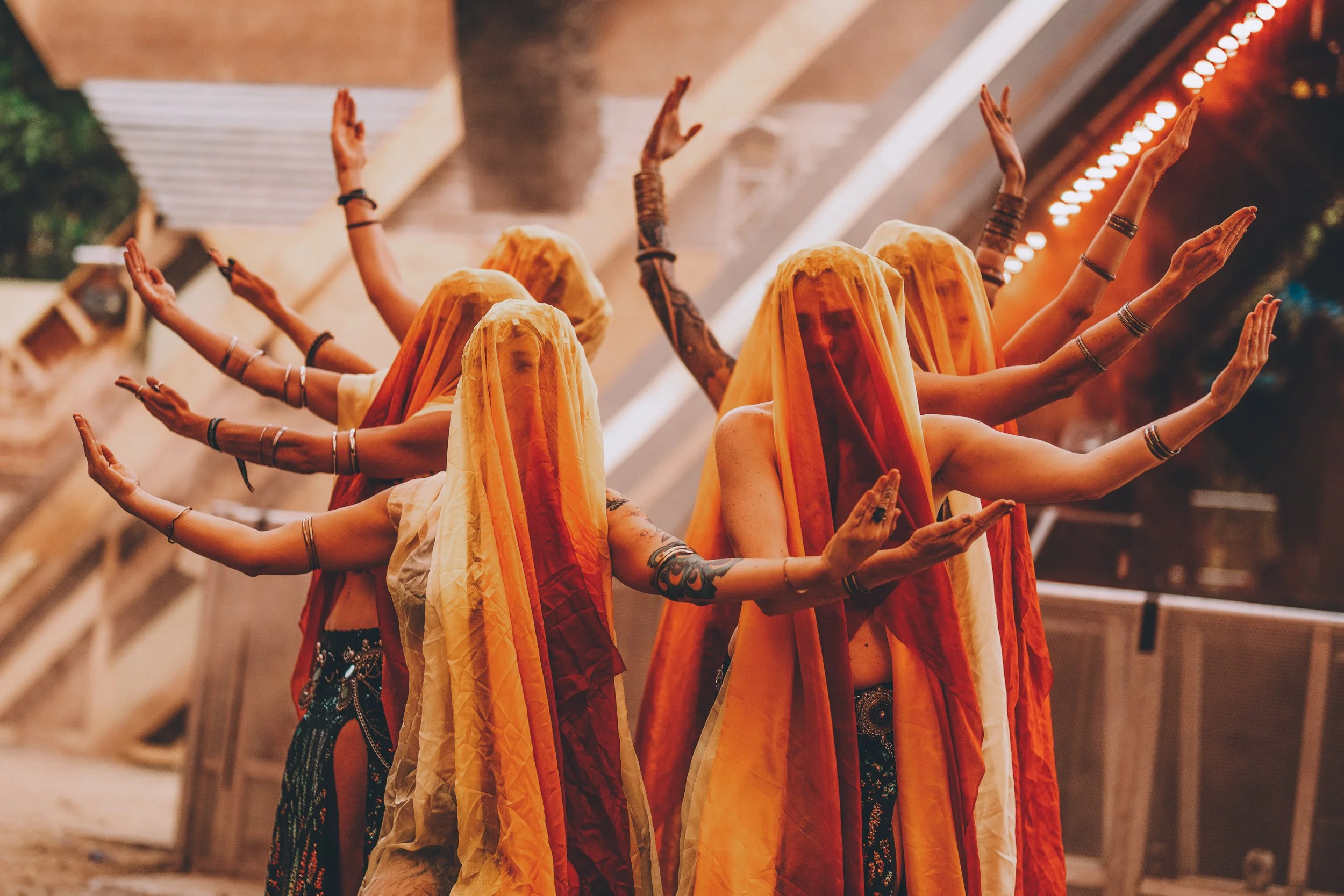
A canvas can change quite a bit while you’re off dancing. At Earth Frequency, artists paint live around Luminarium, on stage and across the festival grounds. Stop to watch and you can follow a picture while its creator is still deciding what happens next.
Luminarium is the festival’s gallery for visionary art, including paintings exploring consciousness and spirituality. Original artworks share the space with prints and jewellery. It’s somewhere to linger over the images, find a favourite and perhaps fall for a piece you would love to live with.
Amanda Sage was among the artists announced for Luminarium in 2020, alongside Luke Brown, Miles Toland and Mugwort. Sage trained in classical painting in Vienna, first apprenticing with Michael Fuchs and then spending ten years as Ernst Fuchs’ painting assistant. Her fantastical imagery comes with a serious grounding in traditional technique.

Watching the brushwork adds another pleasure. A painting can look impossibly intricate from a distance; close up, you can follow the individual strokes. Come back later and see where the artist took it. You might remember the moment a particular colour arrived, long after you’ve forgotten which set you heard that afternoon.
That kind of discovery gives Earth Frequency plenty of life beyond the dancefloor. There are workshops to join and performances to stumble upon, with a theme that gives your own imagination something to play with: Full Bloom.
A stretch, a conversation, a little cabaret
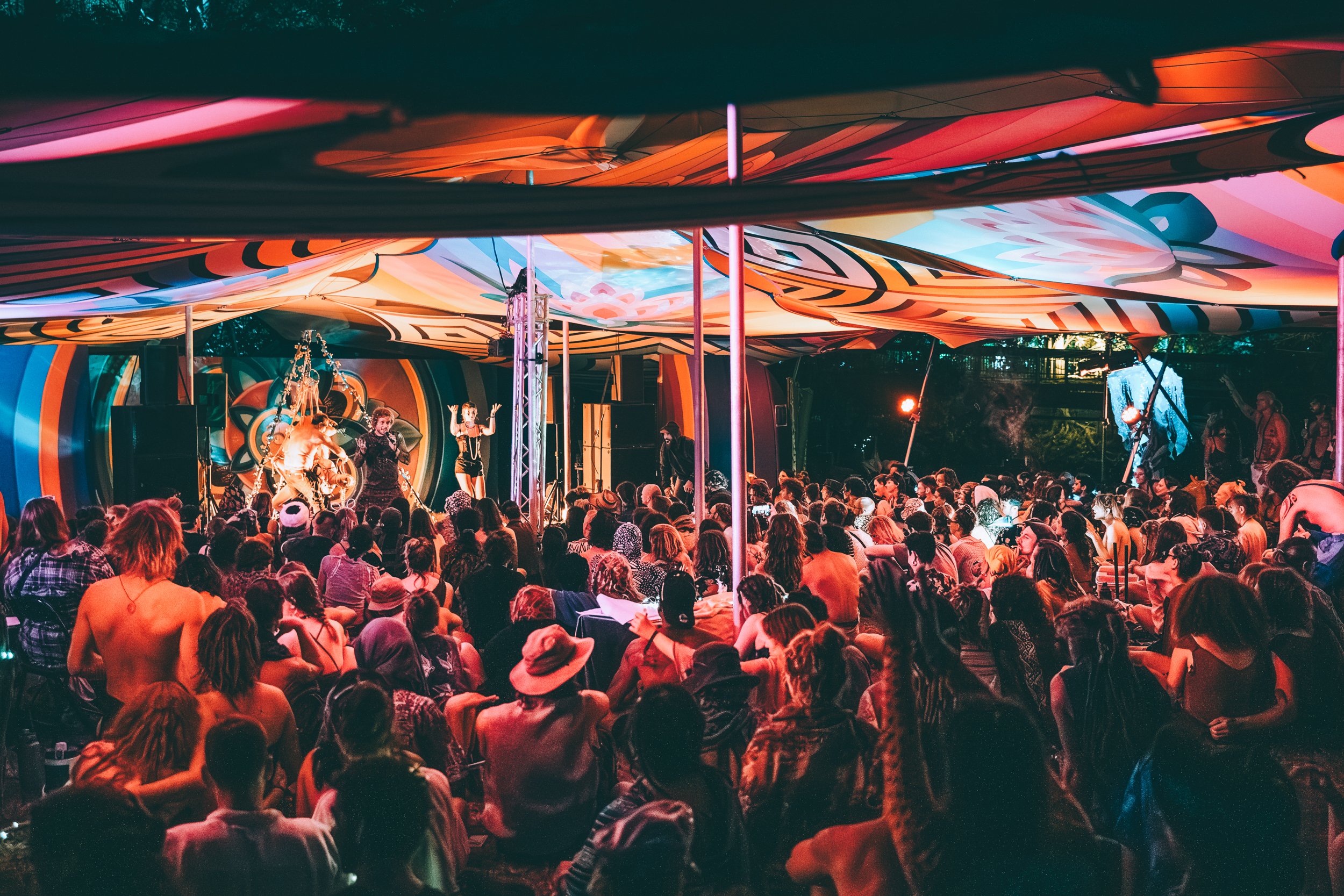
Frequency Village brings together workshops and speakers throughout all four days. Its mix stretches from panels and practical skills to yoga and breathwork, with sacred sound sessions offering another way to listen. Later, cabaret and performance bring a more theatrical flavour to the space.
That mix has a history here. Writing about the 2015 festival for Scenestr, Callum Dorward described workshops divided between spaces called Body, Mind, Healing and Soul. His discoveries included a session on collaborative art in the Body area. Even then, the creative side of the festival extended beyond watching somebody else perform.
The variety is part of the attraction. A workshop gives you something to try; a talk can introduce an idea you’d never have thought to search for. Choose a subject that catches your interest, even when it has nothing to do with your usual hobbies. Being curious is quite enough of a reason to sit down.
Daily yoga and movement sessions offer a different relationship with your body from a long night of dancing. Stretching out can be a pleasure in itself. There is also room for quieter listening, followed by the rather different pleasure of watching someone command a stage.
Bring a friend and see what draws each of you in. The conversation afterwards might be more interesting because you didn’t start with the same opinion.
Sometimes the show finds you
Earth Frequency’s performers don’t all stay on a stage. Roving artists and spontaneous theatre bring characters into the crowd, while choreographed productions and mainstage fire shows offer the bigger spectacle.
A good roving performer can turn a walk across the festival into a comedy scene. A costume catches your eye, a gesture gets a response, and suddenly the trip to meet your friends has acquired a plot. You can enjoy the skill of the performer and the reactions around them at the same time.
Fire performance brings its own fascination: flame following a movement, then vanishing into darkness before the next turn. The attraction is as much the timing and control as the brightness. Give the performers their space and enjoy the view.
The festival also includes a Welcome to Country and opening ceremony. These have a different significance from the entertainment, connecting the gathering to the land and its Traditional Custodians. Earth Frequency takes place on Jinibara Country.
After dark, look up
Light is another of Earth Frequency’s art forms. Its video artists combine projection mapping with stage lighting and LED screens, creating images that change with the music. A surface that looked solid in daylight can appear to shift once moving images pass across it at night.
Patrick O’Neill, the Brisbane artist behind Tricktronix, has taken that relationship between light and movement into visitors’ hands. His Light Portal, documented at Earth Frequency in 2024, turns a screen into an interactive kaleidoscope. People can cast colourful silhouettes by dancing in front of it or bend the screen to distort the image. O’Neill’s project account describes more than a decade of software development behind the piece. A lot of careful coding went into something that invites you to poke it and see what happens.
For a few moments, try watching the visuals as closely as you listen to a favourite track. Notice the textures and the changes in colour. A sudden burst of light can feel completely different when it arrives with the music rather than a second before it. The dancefloor has more than one kind of artist at work.
Away from the stages, sculptures and hanging artworks share the grounds with hand-built shade and places to rest. Some of the festival’s most useful structures are also its most imaginative. You can admire the design while enjoying the very practical pleasure of sitting beneath it.
Love Camp offers a particularly colourful example of people putting their own stamp on the place. Celebrating eleven years at Earth Frequency in 2026, it grew from a small theme camp into an official stage, with plush couches and a conspicuous enthusiasm for giraffes. Its red couch and Geri the Giraffe give the party a personality that began with the people who pitched up together.
Daylight and darkness reward different kinds of attention. In the afternoon, you can appreciate the materials and small details. At night, lanterns and illuminated shapes draw the eye elsewhere. A favourite spot can be worth another visit just to see what the lighting does to it.
Full Bloom is an invitation to dress up
The 2026 theme draws on growth, roots and the natural world. Earth Frequency invites people to express it through upcycled clothing, botanical patterns and handcrafted accessories. There’s plenty to work with before anyone needs to buy a new outfit.
The botanical connection reaches back further than the dress-up theme. Founder Paul Abad recalls Earth Frequency beginning with around 300 people gathering below Maleny for a night of tree planting and music in October 2005. Before there was a four-day festival to decorate, there was a small gathering doing something for the land it occupied.
Think embroidered flowers on an old jacket, fabric petals on a hat or a colour combination borrowed from a favourite plant. Those are starting points, not a dress code. A garden has room for the strange-looking specimens as well as the roses.
You could turn a few fabric scraps into a headpiece, or give an everyday shirt a dramatic new collar. Friends might choose different flowers, different seasons or entirely different interpretations. Half the fun is seeing how far apart the results can be while still belonging to the same idea.
A theme also offers an easy conversation starter. Ask someone about a detail you love. A handmade accessory may come with a story about an experiment, a lucky thrift-shop find or a friend who knows how to sew.
The kids have ideas of their own
The Crib gives younger festivalgoers plenty to get excited about. Craft and science workshops sit alongside circus activities, with face painting and bubbles adding their own appeal. Children can be absorbed in a project one moment and captivated by a performer the next.
Children have been contributing to the festival’s character for years. Scenestr’s 2015 coverage described puppetry workshops for older children and sand play for the younger ones. Around the grounds, families pulled little wagons fitted with cushions, beds and fairy lights. The ingenuity wasn’t confined to the stage builders; some of it had wheels and a bedtime.
It’s a space for families to enjoy together, with a parent or guardian accompanying each child. Family Camping is next door, so a visit can fit comfortably around the rest of the day. The creative part of the weekend can start close to the tent.
Let the children show you what interests them. Their favourite detail may be something you barely noticed, and their verdict on the entertainment is unlikely to arrive wrapped in polite art-world language. There is a lot to enjoy in sharing their enthusiasm.
Somewhere between a wet paintbrush, a burst of flame and a very ambitious homemade hat, Earth Frequency offers plenty of reasons to pause. Follow whatever catches your attention. You might return to camp with a new idea for that jacket.
More festival coverage from Sparked Magazine
Festival guides, sound guides, market guides and reported features from Sparked Magazine.


Keep exploring: start with the full festival guide.
Continue Exploring
 United States
Joshua Tree Fall ’26 Survival Guide
The practical JTMF plan: understand walk-in camping, build wind-ready shade, pack for the nighttime drop and verify the desert conditions that matter.
United States
Joshua Tree Fall ’26 Survival Guide
The practical JTMF plan: understand walk-in camping, build wind-ready shade, pack for the nighttime drop and verify the desert conditions that matter.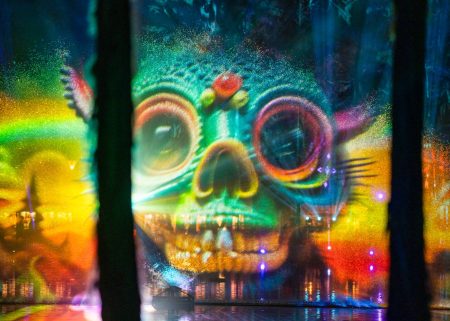 United States
Suwannee Hulaween ’26 Inspo Guide
Hulaween’s art and participatory program work best when readers reserve time for them before the schedule turns every path into a shortcut.
United States
Suwannee Hulaween ’26 Inspo Guide
Hulaween’s art and participatory program work best when readers reserve time for them before the schedule turns every path into a shortcut. Australia
Earth Frequency ’26 Sound Guide
A listener-first route through Earth Frequency’s current psychedelic, club, bass, funk and live programme—corrected for the latest lineup change and honest about the missing timetable.
Australia
Earth Frequency ’26 Sound Guide
A listener-first route through Earth Frequency’s current psychedelic, club, bass, funk and live programme—corrected for the latest lineup change and honest about the missing timetable.