


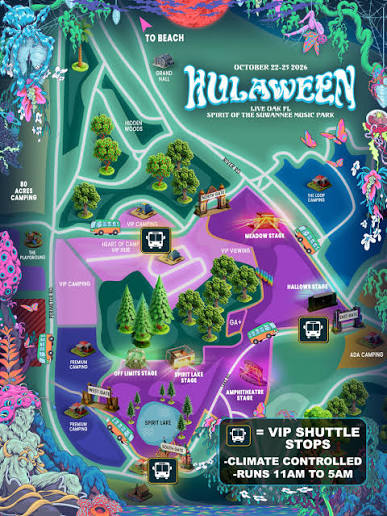
The details that make Hulaween comfortable are easy to overlook while planning the music. A vehicle needs its own credential. A warm afternoon can give way to a cold night. A campsite that seems obvious in daylight can be difficult to recognise after dark. Organise the kit around those conditions: arrival, shelter, sleep, water, food, navigation, access and a rested journey home.
Resolve the travel rule before leaving home
Suwannee Hulaween is scheduled for October 22–25, 2026, at Spirit of the Suwannee Music Park in Live Oak, Florida. Four-day GA includes primitive camping from Thursday morning through Monday noon, but not permission to bring a vehicle into the campground. A Primitive Car Pass or Dry RV Pass is a separate credential. Save the description and receipt for every product you buy, because the festival page and authorized Front Gate checkout have displayed different add-on prices.
Early arrival and car re-entry need clarification before travel. The research found different Tuesday opening times on Front Gate and the festival FAQ, and the FAQ still contains both 2 p.m. and 5 p.m. car re-entry cutoffs. Do not rely on a later time to make a supply run work. Obtain current instructions for your pass, keep them offline and arrange essentials before entering the campground.


The current Jacksonville airport shuttle lists Thursday departures at noon and 4 p.m., with Monday returns at 8 a.m. and noon. Round trips start at US$80 plus fees and one-way tickets at US$45 plus fees. Because a third party operates it, confirm baggage limits, pickup instructions, missed-connection rules and distance to camp. Accessibility lift requests are due at least seven days ahead.
Build camp around sleep, not decoration
Primitive sites are first come, first served, and the current rules say groups may not hold empty space for friends arriving later. Travel together when a shared camp must stay together. Agree on the minimum footprint before reaching the gate, then use the final map—not an old screenshot—to choose landmarks and emergency meeting points.
Shelter must keep the sleeping area dry, control heat and survive ordinary wind. Bring a ground layer, tested rain fly, repair material, suitable stakes, a mallet, shade and one sealed dry-clothing reserve. Do not turn a canopy wall into a sail. Generators are restricted to the designated 80 Acres area and stated hours; fire and grill rules can change. Recheck both before packing fuel.
Make sleep part of the camp plan. The organizer advises warm daytime conditions with nights potentially in the 40s or 50s Fahrenheit. That is not a forecast; it is the reason to bring insulation and then replace the estimate with a current forecast. Earplugs, an eye mask, a warm layer and a dry sleeping system are worth prioritising alongside the clothes and equipment you will use during the day.
Separate water, food and payment backups
The final map must control the location of water, medical care and services. One 2025 reviewer reported limited water access around Spirit Lake and some early Sunday closures; that is a field question, not a universal fact. Arrive with refillable containers, learn the published water points in daylight and carry enough capacity to bridge a detour. Never use decorative or lake water as drinking water.
Food and beverage are cashless; craft and merchandise vendors may accept cash, debit and credit. Carry two payment methods and modest cash. Public Wi-Fi is limited near the Music Hall and Country Store, so keep orders offline and do not make dense-event cellular service your only financial plan.
The organizer expects several dietary categories, but a category label does not answer an allergy question. Named vendors, ingredients, preparation surfaces and cross-contact practices were not available as a complete current inventory on September 1. Bring enough safe backup food to cover at least one service failure and confirm the final cooking, storage and wildlife rules before arrival.
Make navigation work without a signal
Download the final app and map when they exist, then screenshot camp, gates, medical care, accessibility services, water, shuttles and lost-and-found. Share a camp pin, written description and fixed meeting times. Historic reviews describe decorated camps and improvised landmarks as Hulaween culture; they are also practical infrastructure.
Get familiar with the walk between camp and the main programmed areas before dark. The park includes grass, sand, slopes, roots and unlit stretches. Choose footwear for repeated walks and uneven footing, with a dry pair kept in reserve. Carry a small light, protect it from accidental activation and avoid pointing it into faces or performances.
Know the care system—and its limits
The accessibility hub is described near Lost & Found and the General Store. A free onsite wristband is available there. Transportation between stages is not provided. Submit forms early, save confirmations and plan energy around the terrain.
Hulaween says medical stations and Spirit Care support will be available. It also points to Camp Traction as an independent sober-camping community. Verify Camp Traction’s current registration and scope directly; independence matters when assessing what the festival itself provides. The checked official pages did not identify an onsite drug-checking service, so no guide should imply one exists. The venue and festival state a zero-drug-tolerance policy and authorize searches and metal detectors.
Use hearing protection at loud stages. Establish consent before touching, photographing closely or joining someone’s campsite. Know where the nearest substantial building or hard-topped vehicle is before a thunderstorm arrives; the National Weather Service does not consider tents lightning shelters. October remains within Atlantic hurricane season, which creates a monitoring duty, not a prediction. Check the National Hurricane Center, local weather and Hulaween instructions repeatedly during travel week.
Leave with the same discipline used to arrive
Pack critical departure items separately: keys, identification, medication, dry travel clothes, charging cable, vehicle documents, shuttle confirmation and a rubbish plan. Do not bury Monday’s footwear under camp. Confirm the checkout time, shuttle pickup and traffic instructions before the last night. Photograph the empty site after cleaning it.
Before leaving home, confirm credentials, transport, access arrangements and current fire or cooking rules. On arrival, locate water and medical care, then note how to get back to camp in daylight. Before the last night, settle the journey-home plan. Those few decisions leave more attention for the music, costumes and artwork you came to enjoy.
More festival coverage from Sparked Magazine
Festival guides, sound guides, market guides and reported features from Sparked Magazine.


Keep exploring: find art, workshops and wellness in the Inspo Guide and start with the full festival guide.
Continue Exploring
 Australia
Earth Frequency ’26 Inspo Guide
Frequency Village, Luminarium, performance and The Crib give Earth Frequency a second timetable. Here is how to protect time for it before the music schedule takes over.
Australia
Earth Frequency ’26 Inspo Guide
Frequency Village, Luminarium, performance and The Crib give Earth Frequency a second timetable. Here is how to protect time for it before the music schedule takes over. United States
Suwannee Hulaween ’26 Inspo Guide
Hulaween’s art and participatory program work best when readers reserve time for them before the schedule turns every path into a shortcut.
United States
Suwannee Hulaween ’26 Inspo Guide
Hulaween’s art and participatory program work best when readers reserve time for them before the schedule turns every path into a shortcut. United States
Joshua Tree Fall ’26 Survival Guide
The practical JTMF plan: understand walk-in camping, build wind-ready shade, pack for the nighttime drop and verify the desert conditions that matter.
United States
Joshua Tree Fall ’26 Survival Guide
The practical JTMF plan: understand walk-in camping, build wind-ready shade, pack for the nighttime drop and verify the desert conditions that matter.