


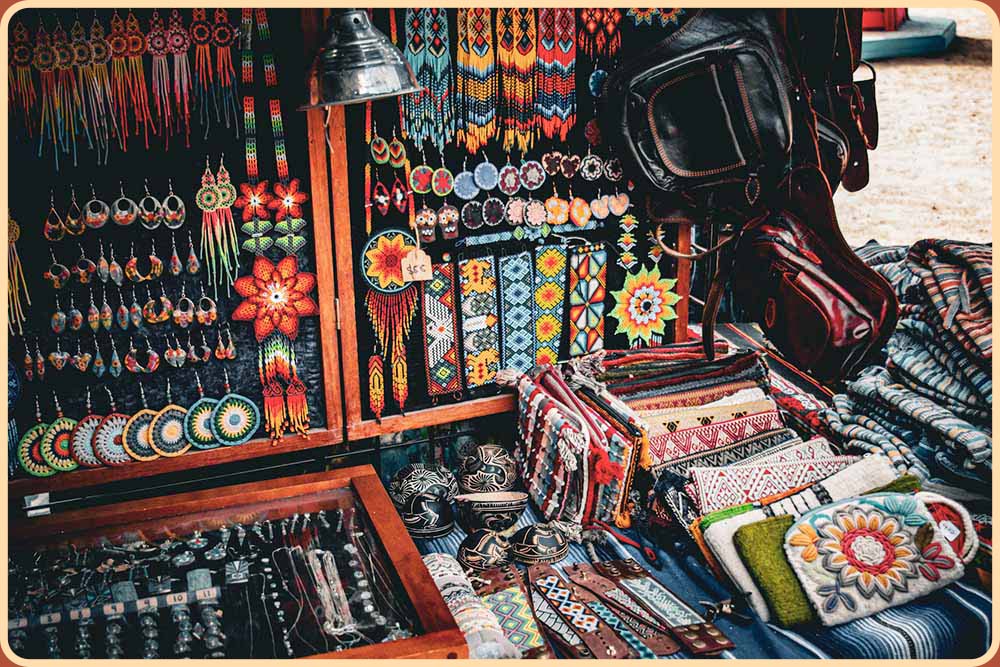
A brocade waistcoat can change the way you enter a room. So can a pair of extravagantly flared jeans, or a leather belt that looks as though it has already travelled somewhere interesting. At Joshua Tree Music Festival, the marketplace offers another way into the weekend: through what you wear, what catches your eye and the people who made it.
The Fall vendor lineup gathers clothing, adornment and art in the Music Bowl, with food nearby and community partners around the lake. Among the labels are circus performers, textile reinventors and leatherworkers with stories that stretch well beyond their stalls. Their collections offer a preview of the possibilities, from a small accessory to an outfit with its own style statement.
Run away with the circus, at least sartorially
Wish Wear is a particularly Joshua Tree place to begin. Founders Zircon and Wish are aerial artists who have staged circus shows in their own local Big Top. Their route into fashion includes a detail worth a second look: Wish studied marketing, while Zircon’s degree is in mechanical and nuclear engineering. Making an entrance was evidently more appealing than choosing just one career.


The label works from a Joshua Tree home studio and uses surplus fabrics sourced in Los Angeles. Its clothes connect that circus background to everyday opportunities for a little theatre. Brocade waistcoats sit alongside printed shorts and fantasy wear; the dark-green waistcoat has an adjustable laced back, giving an ornate piece a useful degree of flexibility.
That is an appealing starting point for a look: a richly patterned waistcoat over something simple, with the rest left to your own sense of mischief. Or take the circus connection further. There is room between “comfortable clothes” and “full ringmaster,” and exploring that space is half the pleasure.
Denim with a previous life
The name Lil Jax comes from maker Asha Tobing’s son, Jaxon. What began as a self-taught hobby became a Santa Cruz clothing practice built around salvaged garments and remnant textiles. Her biography traces influences from Kuala Lumpur to California; her materials bring their own travels into the work.
The signature denim bells make that approach particularly visible. Past pieces shown in her online collection combine existing jeans with additional denim panels, hand stitching and unexpected pockets. One incorporates fabric from a professional painter’s trousers; another remakes overalls with colourful denim and patterned fabric behind distressed areas. These are clues to a garment’s earlier life, carried into a new silhouette.
The wide flare gives the reconstruction a sense of movement. Picture those bells with a close-fitting top, then let the changing washes and stitching do the talking. The appeal goes beyond the familiar word “upcycled”: you can follow the decisions that made this particular pair different. A discarded garment becomes material for someone else’s imagination—and then, potentially, yours.
A wardrobe raised on jungle and thrift stores
De La Luna Designs has a musical backstory that makes its mix of styles more interesting. Founder Virginia Ayala grew up shopping in thrift stores with her family. Her parents’ 1970s style made an impression; later came jungle music, 1990s rave dressing and hip-hop’s baggy trousers and close-fitting tees.
Those influences explain why she resists settling into one visual category. Her collections range through coats, dusters and blazers, with hats and earrings adding smaller ways into the work. Ayala describes a practice of layering fabrics and giving vintage or reused pieces another life. The result is an invitation to put different eras into the same outfit, rather than dress as a perfectly coordinated reference to one of them.
A long coat over an otherwise pared-back look can do a great deal. So can an expressive hat with a favourite old jacket. Ayala’s story offers a useful fashion idea without turning it into a rule: the things you have loved at different points in your life can belong together. Your teenage music taste may have better wardrobe suggestions than you remember.
Leather, stone and a few miles of road
For a different kind of drama, El Gato Montes brings leather and natural stones into boots, hip belts and shoulder holsters. Behind the label are Jamie and Santiago, a husband-and-wife team whose story begins with travelling and learning to make things by hand. Santiago first developed his leatherworking skills while moving through Latin America, and especially Nicaragua.
The studio describes hand-cutting, stitching and stone-setting its pieces in Carlsbad. Its holsters are wearable bags, combining storage with an accessory that becomes part of the outfit’s structure. Custom work allows choices of leather colour and stone, including options such as labradorite, turquoise and amethyst.
There is something satisfying about an accessory doing two jobs this visibly. A stone-set belt can carry essentials and give loose clothing a focal point. A holster can turn a plain top into a more deliberate look while leaving your hands free. Here, the practical detail is part of the design’s attraction; function gets to dress up too.
The pleasure of a generous silhouette
Kin Amora offers another mood: flowing separates and an easy overlap between resort dressing and streetwear. The label describes its clothes as made by artisans in Morocco, with fabric and drape central to the design. Its collection includes wide-leg trousers, tanks and fringe ponchos—pieces with room for movement rather than a demand to stand still and look arranged.
The Stella Wide Leg gives that approach a concrete form. The design pairs a front panel with an elastic back and pockets, using a cotton-and-rayon blend. It is a quieter proposition than brocade or stone-set leather, but a generous trouser shape can be just as expressive.
Try the idea in one colour from shoulder to ankle, then change the mood with an accessory. Or place a fluid layer beside reconstructed denim and see what the contrast does. These are clothes that invite mixing. There is no requirement to keep the festival wardrobe packed away with the tent once you get home.
A small detail can carry a whole place
Not every market discovery needs to become a complete outfit. Bart Bridge builds its hat designs around towns and places, using embroidered patches as small declarations of belonging. The company’s own name came from selling sports fashion on the pedestrian bridge linking a BART station with Oakland’s stadiums. It is a literal place story that became a business about place stories.
An unfamiliar town on somebody’s hat is also a conversational opening. It might be home, a road-trip stop or somewhere they miss. That is a pleasing amount of personality for one small patch.
For something that lives on a wall, Ryan Kerrigan brings a long relationship with music into poster art. His early fascination began with album sleeves and psychedelic posters found at flea markets. He describes listening to a band while drawing, letting the music influence the colours and design. His history includes work with Joshua Tree Music Festival, and his shop extends into prints, pins and stickers.
A piece of music-related art can keep a different part of the weekend alive: the colours and odd little details you might struggle to explain afterwards. Sometimes the thing you take home belongs on your jacket. Sometimes it belongs above the record player.
Leave time for the market itself
The food lineup gives this part of the festival its own reasons to linger. Popping Off Pies brings hand-tossed pizza; Fuego Me Up works with Mexican-Asian fusion; Far East Cowboys draws on northern Chinese and Mongol cooking. JavaGogo, the festival’s own coffee operation, is on the roster too.
Around the lake, the community-partner lineup includes the Mojave Desert Land Trust and Joshua Tree National Park rangers. Their presence adds another connection to the setting: the desert beyond the clothes, the music and the temporary neighbourhood forming around them.
The most interesting thread through this market is how many different inspirations lead to an individual style. Circus performance becomes tailoring. A painter’s old denim becomes part of a new pair of bells. Music heard years ago turns up again in a designer’s choice of silhouette.
Leave room for a find that changes an outfit you already love. It may be the piece you wear on Saturday night, or the one that makes an ordinary Tuesday feel a little less ordinary. The festival ends; a good wardrobe discovery gets to keep going.
Explore the festival market and October tickets, and subscribe to Sparked Magazine for more festival discoveries.
More festival coverage from Sparked Magazine
Festival guides, sound guides, market guides and reported features from Sparked Magazine.


Continue Exploring
 Australia
Earth Frequency ’26 Survival Guide
Woodfordia has permanent amenities, but Earth Frequency remains a four-day outdoor operation. Plan arrival, weather, fire, power, safety, access and Tuesday departure.
Australia
Earth Frequency ’26 Survival Guide
Woodfordia has permanent amenities, but Earth Frequency remains a four-day outdoor operation. Plan arrival, weather, fire, power, safety, access and Tuesday departure. United States
Suwannee Hulaween ’26 Survival Guide
The useful Hulaween checklist is a set of systems: arrival, sleep, weather, water, food, navigation, access, care and departure.
United States
Suwannee Hulaween ’26 Survival Guide
The useful Hulaween checklist is a set of systems: arrival, sleep, weather, water, food, navigation, access, care and departure. United States
Suwannee Hulaween ’26 Inspo Guide
Hulaween’s art and participatory program work best when readers reserve time for them before the schedule turns every path into a shortcut.
United States
Suwannee Hulaween ’26 Inspo Guide
Hulaween’s art and participatory program work best when readers reserve time for them before the schedule turns every path into a shortcut.