


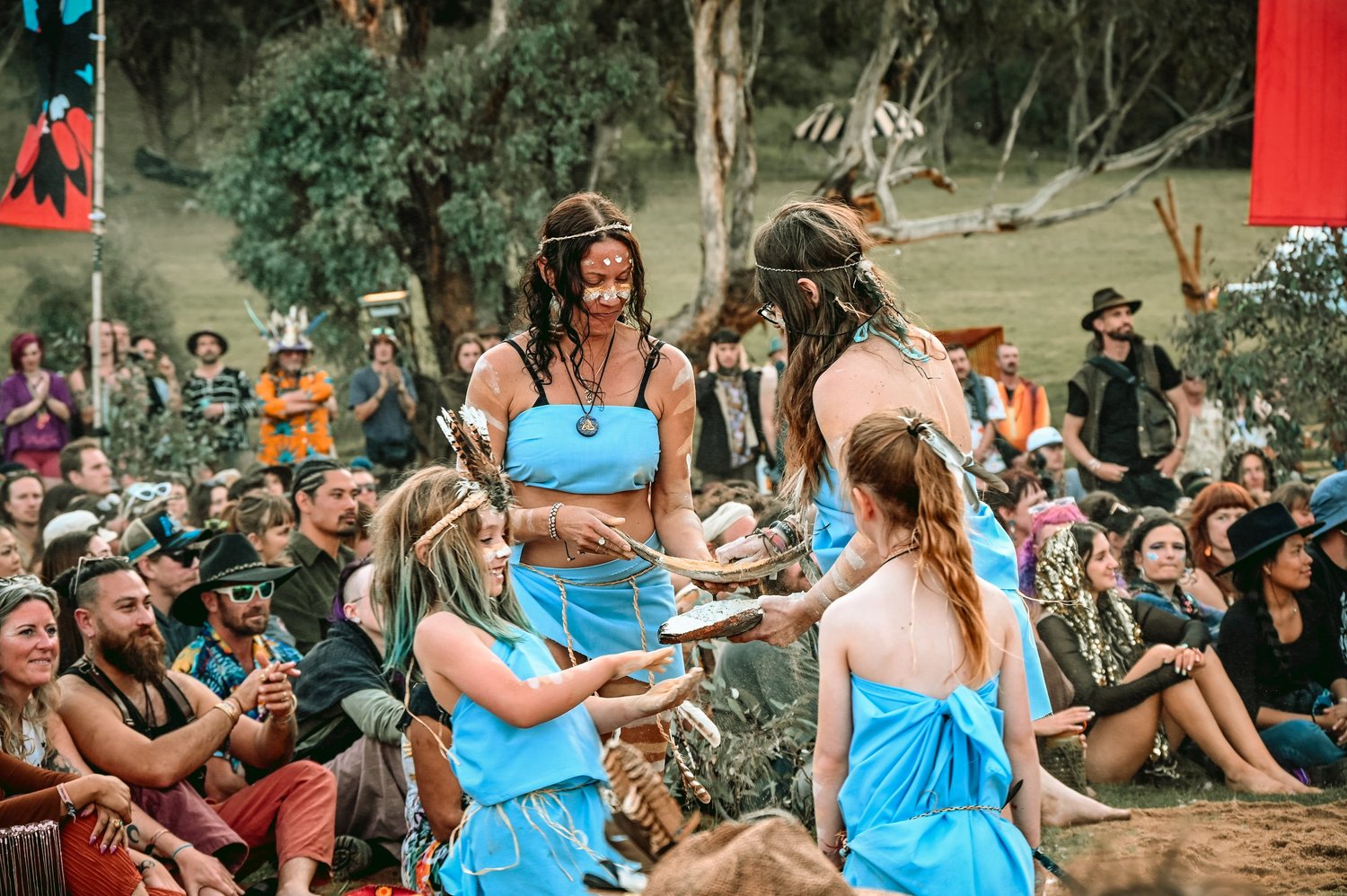
Start with a painting that behaves differently under blacklight. Then look for the people who turn fire into a performance, or spend part of an afternoon helping a new plant into the ground. Dragon Dreaming, September 25–28 beside Lake Burrinjuck, offers reasons to step away from the music without stepping out of the festival.
The attraction is variety you can actually do something with. Art invites a closer look. Performance offers a different use of movement. Tree planting gives your hands a job. You can enjoy the spectacle, join an activity, or discover a creative practice you had never thought to explore.
Dragon’s emerging-artist program adds another pleasure: some of the people attracting your attention are getting an early opportunity to present their work to a festival audience. Their ideas deserve more than a passing glance on the way to the next set.


Lumystria: colour with another trick up its sleeve
Lumystria Studios, named in the festival’s August gallery Hatchling announcement, combines hand-drawn layers with UV-reactive colour. Organic shapes meet geometric forms; fluorescent palettes give the construction another appearance under blacklight.
That combination offers two ways to enjoy the work. From farther away, colour can be the first thing you notice. Up close, the interest shifts to the drawn forms and the relationship between layers. The physical construction is part of the image, rather than something hidden behind it.
Follow an outline, notice where another shape interrupts it, then step back and let the whole composition gather again. A fluorescent shape that first caught your eye can become part of a more intricate drawing. Enjoy the change of scale; the close-up view and the first impression can be quite different pleasures.
This is also a useful reminder that festival art need not stay in the background. A gallery visit can be an event in your day, with its own discoveries and favourite moments. You might remember a particular colour combination as clearly as a song—and find yourself thinking about it the next time you choose clothes or rearrange a room.
Temple of Fire: Byron Bay's regular gathering comes into view
Temple of Fire is a collective of performers and organizers from the Northern Rivers of New South Wales. Its published artist profile describes work ranging from roving appearances to choreographed stage shows. Behind those performances is an ongoing local gathering: Byron Bay’s weekly Temple of Fire show.
The Arts Factory Garden Bar lists it as a Thursday-night event. That weekly rhythm gives the collective a more interesting history than a dramatic promotional photograph alone. These are people building a recurring show together, with a local audience as well as the possibility of taking their work elsewhere.
Dragon’s August Hatchling announcements name the collective among this year’s winners. The performance is worth approaching with your eyes on the movement as much as the flame. Notice how a pause changes the next gesture, or how the direction of a bright line depends on a turn of the performer. Fire attracts attention immediately; a sequence of deliberate movements gives that attention somewhere to go.
Stay for a full passage and let the performers establish their timing. A moving light can suggest a broad sweep or a small, precise gesture; the contrast is part of the pleasure. The collective’s combination of recurring local shows and festival appearances offers a good reason to follow its work beyond this weekend, too.
Put a little of the weekend into the soil
Dragon’s tree-planting invitation is refreshingly tangible. The designated planting zone operates Saturday and Sunday, 9 a.m. to 5 p.m., giving you a substantial daytime window in which to join the work. Some tools and gloves are supplied; bringing your own helps stretch that provision.
The activity carries a history from the Regrowth Tree Planting Festival and REGEN Eco-projects, which merged with Dragon Dreaming. A five-year revegetation plan connects preparation, planting and subsequent care. Habitat corridors and erosion control are among its aims.
For a first-time participant, the useful beginning is the team on the ground: learn how they want the work done, then take your part in it. Working alongside other people gives the activity a social beginning, too. You might arrive to help with a plant and leave remembering the conversation you had while doing it.
It is a different kind of souvenir. Nothing needs wrapping, and the reason to remember it is the part you played rather than an object in your bag. An hour spent helping can sit quite comfortably in the same weekend as dancing until your legs have had enough.
A giant from Dragon's recent past
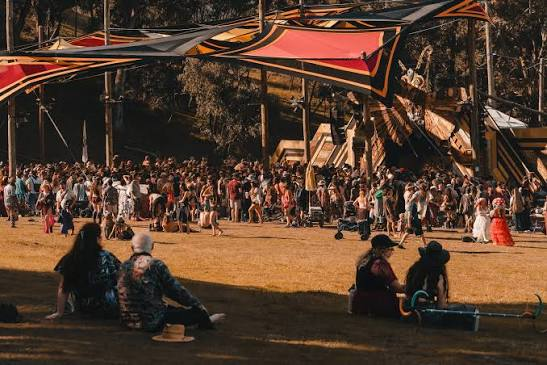
To understand how far festival participation can stretch, look back at Curious Legends. The Newcastle theatre company, founded in 2005, is known for giant illuminated puppets and large-scale outdoor work. Its own record includes Dragon Dreaming appearances; its 2025 Spark photographs offer a particularly good example. This is festival history, not a confirmed 2026 booking.
Spark introduces Nova, a towering illuminated fire-spirit puppet. The production premiered at Newcastle’s Winter Heat in August 2025, with an ambient soundscape accompanying the illuminated figure. Smaller lights and participants can become part of the procession around the central figure.
The company’s associated activities include building handheld spark lanterns and learning how to animate them through movement. That is a lovely change in scale: you do not have to operate the giant to contribute to the picture. A light held by one participant can join others and become part of a much larger performance.
Curious Legends’ wider workshop practice connects making with theatre, offering creative sessions alongside performances or on their own. The point is not merely to manufacture a prop. It is to give someone an object, then explore what they can make it do in company with other people.
The people behind the company have some revealing beginnings. Mitchell Reese started as a musician and travelling storyteller. Alex Fairclough, a mechatronics engineer, works on the custom electronics and LED programming that illuminate the company’s puppets. Storytelling and engineering meet in the same moving creature. The glowing surface is an invitation; the people and skills behind it explain how that invitation becomes possible.
There is humour in the company’s wider puppet collection, too: cheeky ibis chicks made from recycled plastic bags share the family with much larger creatures. The choice of material becomes part of the joke. A familiar Australian bird, recreated from discarded bags, has an entirely different theatrical presence from an illuminated giant.
How a new artist gets the invitation
The Hatchling competition helps explain why emerging work belongs alongside the established attractions. Its 2026 rules ask for developing artists who have not already presented equivalent work at a main-stage level. Community voting creates a shortlist; a professional panel makes the final selection.
The awards include mentoring and promotional material, as well as the festival opportunity. That support gives the appearances a purpose beyond filling a space on the schedule. A performer or visual artist can use the occasion to develop a practice and reach an audience that might not have encountered it elsewhere.
Knowing that changes the pleasure of discovering a name you do not recognise. You are not behind on the homework. The discovery is the point. Take a proper look, give a performance enough time to unfold, or join the planting team for a task you can finish.
A new favourite artist, a closer look at a craft, or a good afternoon doing something unfamiliar would be an excellent result. Go find the thing you had not planned to enjoy.
More festival coverage from Sparked Magazine
Festival guides, sound guides, market guides and reported features from Sparked Magazine.


Keep exploring: start with the full festival guide and explore the festival's makers and market.
Continue Exploring
 Australia
Earth Frequency ’26 Survival Guide
Woodfordia has permanent amenities, but Earth Frequency remains a four-day outdoor operation. Plan arrival, weather, fire, power, safety, access and Tuesday departure.
Australia
Earth Frequency ’26 Survival Guide
Woodfordia has permanent amenities, but Earth Frequency remains a four-day outdoor operation. Plan arrival, weather, fire, power, safety, access and Tuesday departure. United States
Suwannee Hulaween ’26 Survival Guide
The useful Hulaween checklist is a set of systems: arrival, sleep, weather, water, food, navigation, access, care and departure.
United States
Suwannee Hulaween ’26 Survival Guide
The useful Hulaween checklist is a set of systems: arrival, sleep, weather, water, food, navigation, access, care and departure. United States
Joshua Tree Fall ’26 Survival Guide
The practical JTMF plan: understand walk-in camping, build wind-ready shade, pack for the nighttime drop and verify the desert conditions that matter.
United States
Joshua Tree Fall ’26 Survival Guide
The practical JTMF plan: understand walk-in camping, build wind-ready shade, pack for the nighttime drop and verify the desert conditions that matter.