


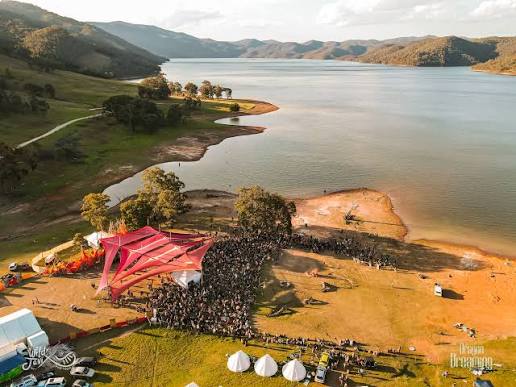
Six weeks after her debut, Nova appeared at Dragon Dreaming. The giant illuminated Fire Spirit had debuted in Curious Legends’ Spark at Newcastle’s WinterHeat on August 16, 2025. The company’s performance record places her at Wee Jasper on September 27. Even imaginary creatures have a touring schedule!
In Spark, the puppet moves among people rather than remaining a distant figure on a stage. Light gives her a presence beyond her physical form. She is an extravagant thing to bring into a rural landscape, and an excellent introduction to the question behind Dragon Dreaming: how does a gathering this unusual find somewhere to belong?
The festival returns to Lake Burrinjuck near Wee Jasper, New South Wales, on September 25–28, 2026. Its lakeside setting now seems inseparable from its character. Yet Dragon’s history begins elsewhere, with an invitation to help build something whose shape was still undefined.


Before the lake
A call for contributors published in May 2009 described Dragon Dreaming’s second year: a three-day alternative arts, music and lifestyle festival in Canberra over the October long weekend. That contemporary notice places the beginning in 2008. More interesting than the anniversary arithmetic is what the organizers were asking people to bring.
Electronic and live music were both welcome, with an emphasis on artists from Australia and Aotearoa. The invitation to installation artists was particularly accommodating: “we have space for almost anything!” Roving performers belonged in the plan alongside stage acts. Volunteers were needed for such unglamorous essentials as firewood, toilets and leaving the site clean.
It is an appealingly candid early portrait. The ambitious imaginary world and the work required to host it appear in the same classified. Someone could arrive with an improbable artwork; someone else would have to make sure the toilets worked. Neither contribution was incidental to the gathering.
The festival has occupied Cooradigbee, north of Wee Jasper village beside Burrinjuck, since 2013. Its history therefore has two beginnings worth distinguishing: the formation of the event, and its arrival in the landscape that would become its home.
A change of setting does not explain every subsequent decision. It does change what the festival has to work with. The possibility advertised in that early contributor notice acquired a particular shoreline, a stretch of grassland and neighbours whose lives did not begin just when the music started.
The land gets a say
Dragon’s connection with planting also has an organizational history. Its own account describes a merger with the Regrowth Tree Planting Festival, associated with REGEN Eco-projects. A tradition organized around putting plants into the ground became part of the gathering’s identity, rather than simply another activity added to the weekend.
The festival describes a five-year revegetation management plan for the Wee Jasper site, covering preparation, planting and subsequent care. Its stated aims include addressing erosion and creating habitat corridors. Attendees are invited to participate in the work.
The timescale is the interesting part. Most festival production is designed to arrive, function intensely and leave. Planting asks for attention after the audience has gone home. It introduces a different answer to the question of what a visitor might contribute: something whose intended life extends beyond the event that brought them there.
Those plans and invitations are not proof of ecological success. That would require evidence about what survives and how the land responds. But they do establish a more involved ambition than treating the landscape as a backdrop.
A much smaller detail makes the same point without any grand environmental language. Dragon’s FAQ prohibits blue tarps, explaining that they fragment into micro-rubbish. Its entry conditions also cite concern for livestock. The rule has a wonderfully practical specificity: fabulous costumes are encouraged, but the cheap blue sheet does not get the same welcome.
The distinction makes sense on a working property. An outfit can leave with its owner. Loose fragments may stay behind.
There is also a much longer relationship with this place than the festival’s own. Dragon acknowledges the Ngunnawal and Wiradjuri peoples and their continuing connection to Country. Finding a recurring home here means being a guest within that history, not writing over it with an origin story that starts in 2008 or 2013.
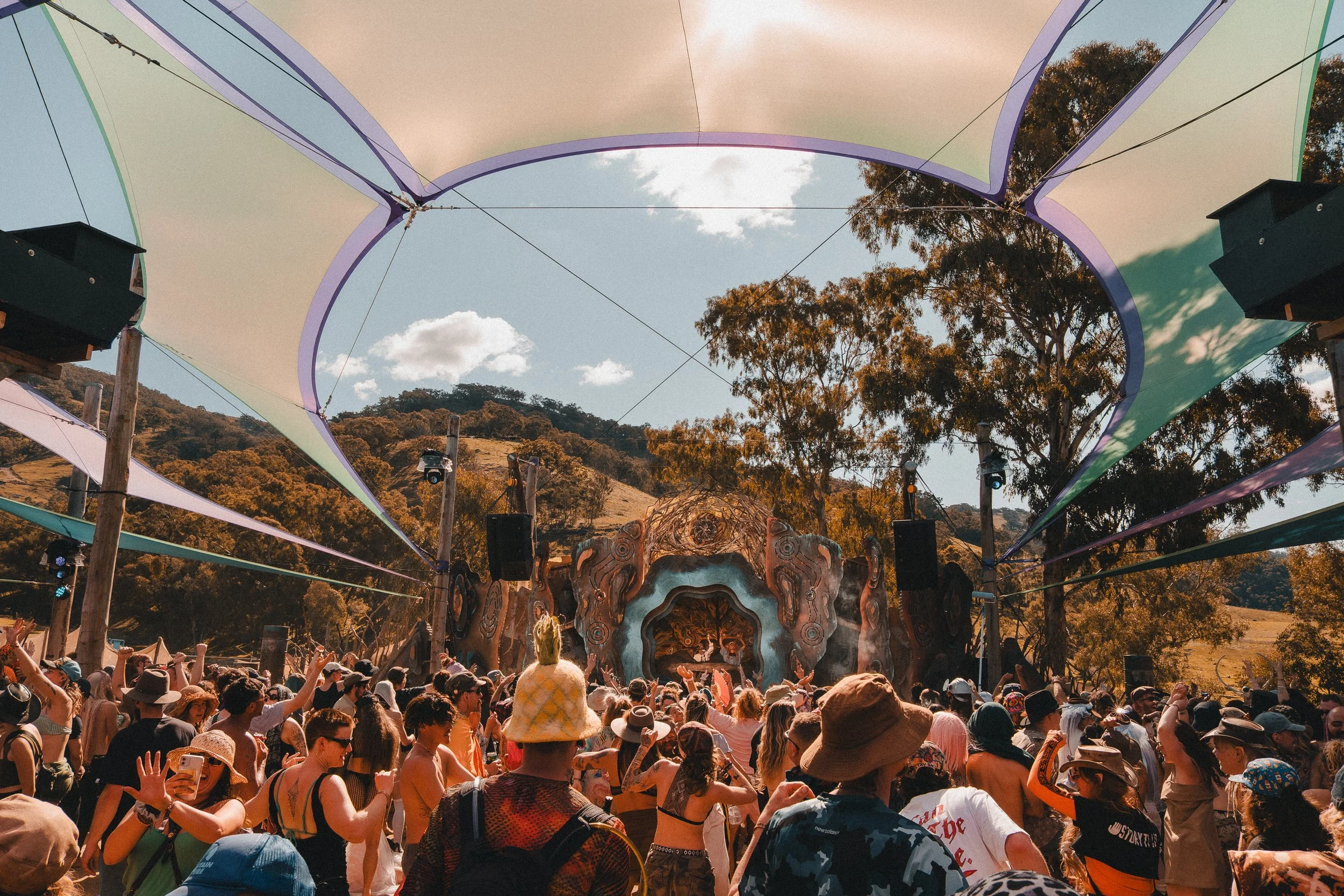
Becoming part of local life
Room for the improbable
Go back to Nova and the apparently impossible creature becomes an encounter between very recognizable skills. Curious Legends’ company biographies describe Mitchell Reese’s beginnings as a musician and travelling storyteller, alongside Alex Fairclough’s work as a mechatronics engineer developing electronics and programming lighting for its puppets. Storytelling and circuitry are perfectly sensible colleagues once the task is to animate a giant.
That combination belongs to a wider creative culture, not only to this festival. Nova’s journey from Newcastle to Wee Jasper brought one piece of it into Dragon’s temporary world. A distinctive place can be made through what it welcomes as well as what it invents itself.
Dragon’s Hatchling competition keeps an opening for less-established contributors, with eligibility aimed at creatives who have not already had a main-stage or equivalent festival appearance. It is a small connection back to the early invitation: the gathering still makes an explicit place for someone who has not yet become familiar.
That does not mean repeating 2009 indefinitely. The lake, the planting tradition and the negotiations around returning have all added something. Continuity allows new people and ideas into a place with an existing character; it need not preserve the event under glass.
Nova offers a rather better image than glass. A luminous giant, made elsewhere, can arrive in a valley and briefly belong to the world assembled there. Then the performance ends. The people who tend the land, negotiate the next gathering and maintain the local relationships are left with a longer task. They are making room for whatever improbable thing might arrive next.
More festival coverage from Sparked Magazine
Festival guides, sound guides, market guides and reported features from Sparked Magazine.


Keep exploring: start with the full festival guide and explore the festival's makers and market.
Continue Exploring
 United States
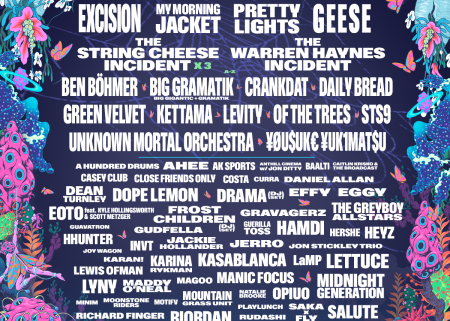
Suwannee Hulaween ’26 Sound Guide
The 2026 bill is too mixed to reduce to headliners. A better route follows live improvisation, electronic scale, rhythm and the collaborations that blur those categories.
United States
Suwannee Hulaween ’26 Sound Guide
The 2026 bill is too mixed to reduce to headliners. A better route follows live improvisation, electronic scale, rhythm and the collaborations that blur those categories. Australia
Earth Frequency ’26 Market Guide
Use Earth Frequency’s Full Bloom theme as an anti-disposable buying rule: rewear, upcycle and leave room for current makers—without pretending an unpublished vendor roster is already known.
Australia
Earth Frequency ’26 Market Guide
Use Earth Frequency’s Full Bloom theme as an anti-disposable buying rule: rewear, upcycle and leave room for current makers—without pretending an unpublished vendor roster is already known. Australia
Dragon Dreaming ’26 Survival Guide
Dragon Dreaming runs at Wee Jasper from 25 to 28 September 2026. The weekend becomes much easier when arrival, sleep, weather, water, food and departure are treated as part of…
Australia
Dragon Dreaming ’26 Survival Guide
Dragon Dreaming runs at Wee Jasper from 25 to 28 September 2026. The weekend becomes much easier when arrival, sleep, weather, water, food and departure are treated as part of…